- Big Business This Week
- Posts
- Can Warsh prove his independence?
Can Warsh prove his independence?
Plus: Meta lays off 10% of its workforce to pay for its AI investments

Cheddar's Big Business This Week
April 23, 2026
TODAY’S NEWSLETTER IS BROUGHT TO YOU BY:

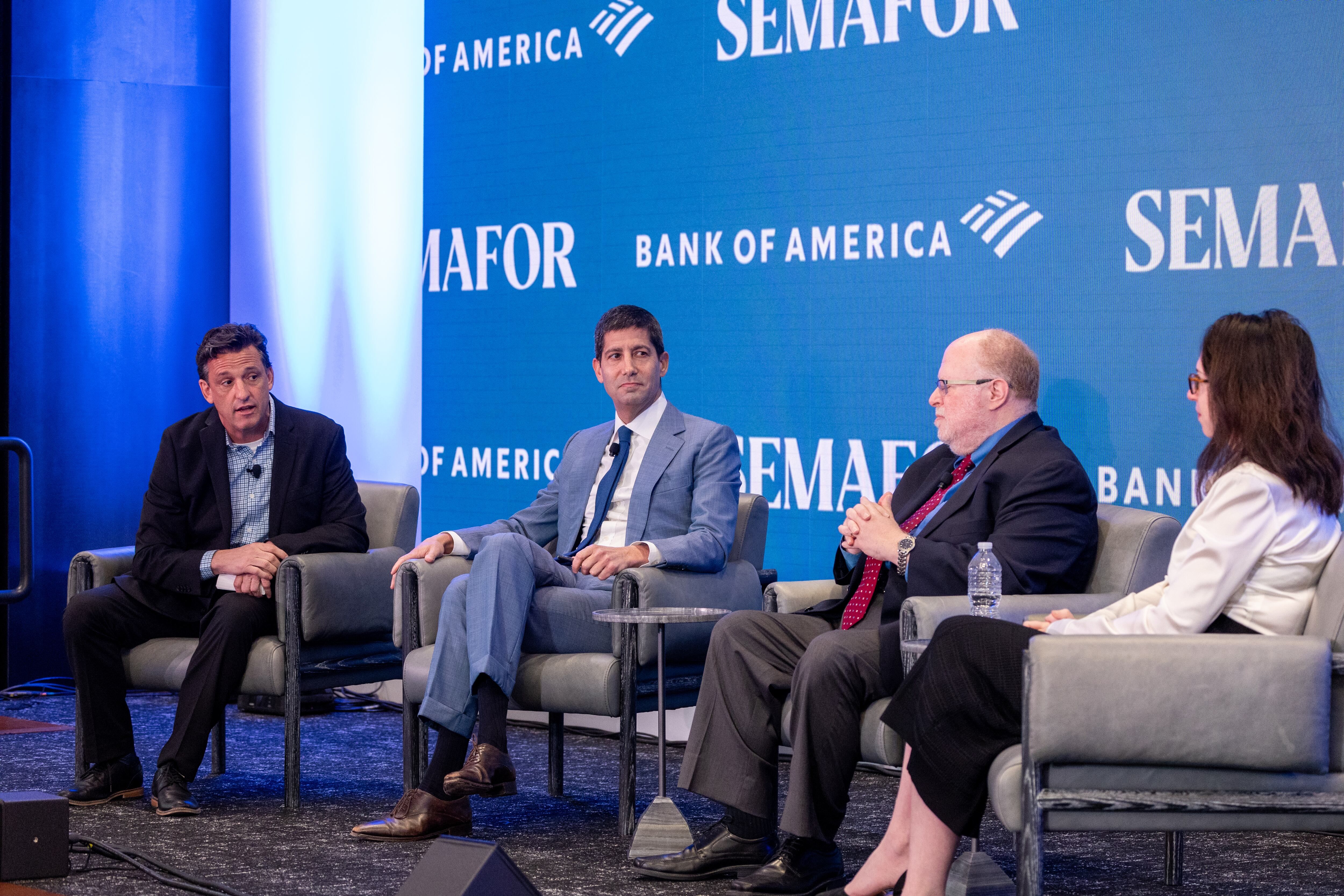
Kevin Warsh, second from left (Getty Images)
Sometimes it helps to have friends in high places, and sometimes it doesn’t. Just ask Kevin Warsh, President Trump’s nominee to be the next chair of the Federal Reserve.
At a three-hour hearing on Tuesday, members of the Senate banking committee grilled Warsh on everything from how independent he’d keep the Fed (independent, he said), to whether he’s just a “human sock puppet” for Donald Trump (no, he said) to whether he invested any of his $100 million personal fortune with Jeffrey Epstein (Warsh, somewhat ominously, wouldn’t answer that question despite being asked for a simple “yes-no answer” by Democratic Senator Elizabeth Warren).
There’s a lot at stake here. Jay Powell, whose term expires next month, has been resolute in keeping interest rates up to stave off inflation, even as President Trump has tried to politicize the Fed, pushing Powell to cut rates, even letting former AG Pam Bondi investigate Powell for overspending on a rehab of the Fed headquarters. That's a sore point: Sen. Thom Tillis, a North Carolina Republican, said he won’t approve any nominee until the Powell investigation is closed.
Trump put Warsh through an Apprentice-style tryout for months before selecting him, and while he is the president’s candidate, it’s not easy having a friend like Trump. While Warsh told the committee that Trump had “never asked me to predetermine, commit, fix, decide on any interest rate decision in any of our discussions, nor would I ever agree to do so,” just hours earlier, Trump told CNBC he’d be “disappointed” if Warsh didn't cut interest rates.
Warsh has been a Fed governor under Ben Bernanke from 2006 to 2011, and studied economics at Stanford with supply-side guru Milton Friedman. The big question for Warsh is: Will he resist Trump’s pressure to cut rates before November's midterm elections, even if that means fueling inflation down the road?
Fed watcher Ethan Harris, former head of global economic research at Bank of America, notes that Warsh has done an about-face on rate policy, first a reliable hawk warning not to cut rates because easy money could spur inflation, then taking Trump's line that the economy is already in a golden age of AI-fueled high productivity and growth, with low inflation. Warsh's views have shifted over time, and there's even an Economist chart going around showing how his views on interest rates change with whoever is in office:

“The claim of a “golden age” for the economy allows a new Fed Chair to both claim full independence from the President and do what the President wants for monetary policy,” Harris wrote in a blog post this week. “The test of his true feathers will come when he does or does not react to evidence that there is no golden age and inflation is remaining sticky high.”
One key aspect of the Fed chair’s job is communication. Markets dissect every pause and every comma the fed chair utters, and Claudia Sahm, Chief Economist at New Century Advisors, notes that Walsh’s refusal to answer direct questions or clearly state his views on monetary policy and inflation don’t bode well for his tenure. Business and investors want certainty, and they want clear signals about where the Fed plans to move interest rates and why. That’s why they pore over those Fed minutes.
”I have concerns that he’ll shape his role at the Fed to be the good Fed chair that the president wants,” Sahm said in an interview with BBTW. And that would be bad for the economy, she added. “When politics get into the mix, things tend to go off the rails in terms of inflation and economic stability, so interest rates matter. It affects businesses and households, you want these decisions to be made in a thoughtful way that’s connected to reality and not to politics.”
Chris Hodge, chief U.S. economist at investment bank Natixis, says he thinks Warsh will do a fine job as chair. “He is going to take the job seriously, because he knows he’ll be in the history books,” Hodge said in an interview with BBTW, especially having undergone a year-long public audition for the job. “He’s been on the record for 20 years taking a hawkish stance on rates, so don’t take the last 18 months at face value,” said Hodge.
Hodge says Warsh can be expected to work with the Fed staff and other governors, and he likes some of the changes Warsh is proposing, including fewer public statements and press conferences by the Open Markets Committee, and do away with the Fed’s famous—and anonymous—dot chart, which shows where various members of the committee stand on raising rates. “Do I think Warsh will maintain the Fed’s independence? Yes,” said Hodge. “He’ll be making policy for posterity. Plus, he’ll be moderated by the markets.”
But the bigger problem goes back to Trump, said Sahm. “Normally, by the time you go before the senate for your confirmation hearing, you’ve won the confidence of the President," said Sahm. But Trump hasn’t called off the probe into Powell, a clear sign, says Sahm, that the President is using the threat against Powell as a way to keep Warsh singing to his tune on interest rates.
But ultimately, both Sahm and Hodge agree, the biggest force insulating Warsh from Trump’s potential interference is the fact that even as chair, Warsh is only one of 12 votes on the panel.
—Peter S. Green
Big Businesses mentioned this week
$BBY ( ▲ 6.07% ) $UBER ( ▲ 2.14% ) $SAVEQ ( ▲ 0.43% ) $X ( ▼ 0.02% ) $INTC ( ▼ 8.04% ) $JBLU ( ▼ 9.56% ) $UAL ( ▲ 0.33% ) $AAL ( ▲ 2.98% ) $AAPL ( ▲ 1.23% ) $GOOG ( ▼ 3.08% ) $MSFT ( ▼ 2.23% ) $AMZN ( ▼ 4.57% ) $META ( ▼ 6.98% ) $ORCL ( ▼ 2.78% ) $DJT ( ▼ 0.75% ) $TSLA ( ▼ 3.08% )
This week, big business!
War Story
Dire Straits: The dispute over who is going to let whose ships go through the Strait of Hormuz is having some serious effects on the global economy. Deep-pocketed countries from China and Japan to the U.S and Europe can buy what they need on the open market, paying whatever it takes, but smaller Asian countries, and especially African nations, are feeling the squeeze in their supply chains, and Southeast Asian economies that depend on imported fuel for manufacturing exports face grinding to a halt. “Once again, a large unanticipated shock hits the world economy and it’s every country for itself,” Eswar Prasad, a Cornell economist, told the New York Times. “This is not the world in it together and trying to sort out the problem jointly. Every country is going into survival mode.” The Philippines declared a national energy emergency last month, and in India the government has been raiding hoarders of cooking gas. Every rumor of cease-fire and renewed hostility sends stock prices and oil futures rushing in opposite directions, and the disruption has been so great that President Trump said on Tuesday he may offer U.S. financial support to the oil-rich United Arab Emirates. Meanwhile countries that had gotten their energy from the Gulf are looking elsewhere and old pipelines are coming back into service to avoid the Persian Gulf. Singapore’s foreign minister warned that the Hormuz debacle is just a “a dry run” for what will happen to global energy and commerce if China moves against Taiwan or the Philippines, closing the Strait of Malacca or the South China Sea. Meanwhile oil prices show no sign of coming back to where they were before the U.S.and Israel began bombing Iran on Feb. 28. Brent Crude spot prices are back over $100 barrel, and domestic gasoline prices are not coming down anytime soon. The average price for a gallon of gas in the U.S. was $4.03 on Thursday. Energy Secretary Chris Wright told CNN over the weekend that gasoline might not fall below $3 a gallon until 2027, but after President Trump said on Monday that Wright was…er…wrong, the energy secretary told a Senate hearing on Wednesday that he’d said no such thing. “I don’t know the future of energy prices,” he told the Senate Energy Committee.
ADVERTISEMENT

Keebeck Wealth Management: A modern advisory firm built for founders and families.
We offer a thoughtful, relationship-driven approach designed to bring clarity and confidence to complex financial decisions. Our team focuses on understanding each client’s goals, creating comprehensive plans, and providing transparent guidance every step of the way.
At Keebeck, we believe effective advice comes from alignment, communication, and disciplined thinking. We use technology and a collaborative process to help clients stay informed and prepared as their needs evolve.
Our mission is simple: to empower you with the insight and structure needed to navigate your financial future with purpose.
Keebeck Wealth Management — Helping you become the CEO of your capital.
* Information provided is general in nature and does not constitute personalized investment advice. A professional adviser should be consulted before implementing any of the options presented. Any tax and estate planning information provided is general in nature and should not be construed as legal or tax advice. Always consult an attorney or tax professional regarding your specific legal or tax situation. The use of generative AI (artificial intelligence) will allow users to ask general questions, not provided by a human. This service will rely on third-party sources of data and information. We cannot guarantee the accuracy of such information, and the user should take steps to verify information provided herein. Information provided on or through this service is not an offer to buy or sell, or a solicitation of any offer to buy or sell the securities mentioned herein. Hyperlinks on this website are provided as a convenience and we disclaim any responsibility for information, services or products found on pages linked hereto. Our annual fee for portfolio management services is equal a percentage of the market value of your assets under our management. You will be charged, separate from and in addition to your management fee, any applicable Platform Fees as well as applicable independent manager fees. We do not receive any portion of the fees paid directly to third party service providers, including the independent managers.
END OF ADVERTISEMENT
The Usual Suspects
Better Buy? Best Buy $BBY ( ▲ 6.07% ) CEO Corie Barry will step down this year, replaced by chief customer, product and fulfillment officer Jason Bonfig. Barry led BestBuy through the challenges from Covid and Amazon, which saw other specialty mega-retailers like Circuit City and Sports Authority shut down. Sales barely grew under her leadership, a trend that’s difficult to interpret as tech products increasingly ship direct to consumers. Shares also rose only 6.2% under Barry, as the S&P jumped 157%. They dropped 6% on the news of her departure.
Can Red Lobster Claw its Way Back? Emerging from bankruptcy, seafood chain Red Lobster just can’t quit Endless Shrimp, the menu item some said was to blame for its troubles (it really wasn't the culprit, according to my sources at Quartz). This time you can’t get it delivered (it’s not clear how that “endless” thing would have worked with UberEats) and it's only available on certain days. Two years after entering bankruptcy protection, sales were down 6% last year from 2024, and the Lob is trying to renegotiate more leases and close more unprofitable locations.
Uber Trouble: Ride-share firm Uber $UBER ( ▲ 2.14% ) just lost its second sexual assault case, this time in North Carolina where a jury found the company liable for a 2019 assault by a driver on a young female passenger. Brianna Messing only won a $5,000 judgment, but the case is seen as a bellwether for the 3,000 more sexual assault cases against Uber. In February, a Phoenix jury ordered Uber to pay $8.5 million to a passenger raped by a driver. At issue: not only whether Uber adequately screens its drivers and provides adequate safety protection for riders, but whether the drivers are effectively employees or contractors, making the company liable for their actions. Shares in Uber are down more than 9% this year.
Spirit in the Sky, Again? The President is now positioning himself as the savior of a not-quite holy Spirit $SAVEQ ( ▲ 0.43% ) , the bankrupt airline. “Maybe the federal government should help that one out,” Trump told CNBC on Tuesday. By Wednesday, the Dept. of Transportation was in talks to extend a cash lifeline to Spirit in exchange for warrants giving it a stake in the failed carrier. Remember U.S. Steel $X ( ▼ 0.02% ) and Intel $INTC ( ▼ 8.04% ) ? At least those companies had a national security element, but do cheap Florida vacations deserve DefCon4 status? Spirit went bankrupt twice after bigger airlines offered their own super-economy fares and federal trust-busters blocked a planned merger with Jet Blue $JBLU ( ▼ 9.56% ) . Now it looks like a Dept of Transportation-Spirit merger may be in the works.
Not so fast for United and American. Some of those same pressures, plus the Iran War double whammy of higher fuel prices and nervous passengers, prompted talk this month of United Airlines $UAL ( ▲ 0.33% ) merging with long-time rival American $AAL ( ▲ 2.98% ) , the smallest of the major U.S. airlines. But that move was quickly shot down by both American and some top politicians, including a bipartisan group of U.S. senators who warned the two carriers that a merger could lead to higher air fares and fewer flights in overlapping markets. United has slashed its 2026 earnings forecast to $7 per share from a January prediction of $12.
Not the Onion: That satirical news site says it reached agreement to rent what’s left of Infowars, the right-wing conspiracy site that host Alex Jones lost in a defamation suit when he called the 2012 Sandy Hook elementary school mass shooting a “hoax.” It wasn’t. It left 20 children aged six and seven dead, and killed six adults who were trying to protect the kids. It also cost Jones his media empire, which at one point had 2.4 million YouTube subscribers. A bankruptcy court judge barred the Onion from buying InfoWars, so now it will be renting the site for $81,000 a month (the money goes to Sandy Hook survivors and victims’ families). Oddly, Jones continues to run the site. The Onion says it plans to run InfoWars as a parody of Jones and his bombastic conspiracy theories. “We are excited to lie constantly for cold, hard cash, but this time in a cool way, and we’ll make sure some of it gets back to the families,” said Ben Collins, CEO of Onion parent Global Tetrahedron. Jones, who doesn’t seem to be taking it too well, took his shirt off and ranted about the move on the website formerly known as “Russia Today”:
Tech talk
Apple Turnover: Apple $AAPL ( ▲ 1.23% ) CEO Tim Cook will step down Sept 1 after 15 years at the tech giant, where he presided over a 30-fold increase in the company’s share price, turned the iconic iPhone into the world’s most ubiquitous power symbol, and introduced the Apple Watch, Airpods and AppleTV+. Replacing him is John Ternus, Apple’s 50-year-old senior vice president of hardware engineering. Temus, a 25-year veteran of the tech firm, oversaw the development of the iPad and the new $599 MacBook Neo. His big challenge will be steering Apple through the AI era, and finding new reasons for consumers to get excited about its products. He’ll have big shoes to fill. Cook has also become Silicon Valley’s top diplomat defending the tech industry’s far-flung empire to successive U.S. administrations, and in Beijing, a role Cook will keep in a new position as executive chair. As recently as February Cook was knocking down reports he’d be stepping down. Apple is at a clear turning point. In a world of chatbots, Siri is nearly obsolete, and Apple has ceded the race to develop the next gen AI to rivals and upstarts from Google $GOOG ( ▼ 3.08% ) and Microsoft $MSFT ( ▼ 2.23% ) T to OpenAI and Anthropic. Cook, who was tapped by Steve Jobs as Apple’s mercurial founder lay dying of pancreatic cancer, recently told the Wall Street Journal the advice he’d give his eventual successor: “Be yourself,” said Cook. “Keep a firm North Star on the values of the company.”
The circularity continues: Amazon $AMZN ( ▼ 4.57% ) is tightening its bonds with Anthropic in a circular financing deal that swaps $5 billion in Amazon cash for an Anthropic promise to buy $100 billion in Amazon computing capacity (aka “compute”), and Amazon says its total investment could hit $25 billion. Anthropic promised to use 5 gigawatts worth of Amazon’s own AI proprietary AI chips, which may bestow legitimacy on these bespoke chips. It’s all part of a push by tech firms to be at the front of the pack as AI becomes a big slice of everyday business. But Amazon’s announced plans to spend $200 billion on capex this year, most of it AI-related, have analysts wondering if Amazon will do enough AI business to justify the spending. Back in February, Amazon shares dropped 9% in the hours after it announced the $200 billion plan, a 60% increase from 2025 spending. A report out this week from AI customer-service platform Parloa finds that only about 5% of large consumer-facing firms have AI chatbots on their websites, so either there’s room to grow, or there’s no demand. Meanwhile, the AI spending rage continues with Microsoft $MSFT ( ▼ 2.23% ) , Meta $META ( ▼ 6.98% ) , Alphabet $GOOG ( ▼ 3.08% ) , Amazon $AMZN ( ▼ 4.57% ) , and Oracle $ORCL ( ▼ 2.78% ) planning to spend a collective $700 billion on AI-related infrastructure this year.That’s more than Gerrmany’s federal budget.
Satoshi Solved? The latest digital detectives to weigh in on the true identity of bitcoin founder Satoshi Nakamoto say two dead guys invented Bitcoin: Belgian cryptologist Len Sassaman and Hal Finnery, a Silicon Valley developer and cypherpunk. Sassaman killed himself in 2011, and Finney died of Lou Gehrig’s disease in 2014. Both have previously been named as Bitcoin’s creators, and both have had their roles posthumously debunked. Sassaman famously tweeted back in 2010 that Bitcoin was “bunk.” Still, former investment banker and Puck journo William D. Cohan and his investigative partner, private eye Tyler Maroney say they’re right and have posted their film at findingsatoshi.com where you can watch it for $17.88. That’s a lot less than a bitcoin.
Face/Off. Meta $META ( ▼ 6.98% ) is cutting 10% of its workforce, or 8,000 jobs, in an effort to offset its AI spent, according to an internal memo reported by Bloomberg. The company disclosed the move in a memo sent to employees Thursday, saying the layoffs will come on May 20. Meta also won’t hire workers for 6,000 open roles that it had intended to fill. “We’re doing this as part of our continued effort to run the company more efficiently and to allow us to offset the other investments we’re making,” chief people office Janelle Gale told employees, according to the memo. “This is not an easy tradeoff and it will mean letting go of people who have made meaningful contributions to Meta during their time here.” Meta spent tens of billions on its metaverse efforts, which largely failed. The company has also had to make major investments in its AI efforts in order to keep up with competitors in the space — earlier this month, it debuted a completely overhauled AI product called Muse Spark. Still, the firm’s stock is up 118% over five years and fell just 2% on the news.
Trumplandia
“You’re Fired”: Donald Trump, Jr. fired former GOP congressman Devin Nunes as head of the family’s Trump Media & Technology $DJT ( ▼ 0.75% ) . Nunes said it was “an appropriate time” to leave the firm. Last year, Trump Media lost $712 million on $3.7 million in revenue, and the company says it's now planning to merge with a nuclear fusion company. Shares have lost 85% of their value in the last two years.
Names on Things Dept.: When a family of Syrian-born investors won $12 billion of Syrian government contracts to rebuild the war-torn country, including a luxury seaside development, they were blocked by one thing: U.S. sanctions imposed on the country during the rule of its former despot, Bashar al-Assad. The solution? Propose a Trump-branded resort and golf course. (The brothers are also negotiating a Trump-branded resort in Albania with Jared Kushner). The Trump Administration says no talks on a Trump-branded Syrian golf course are under way, but shortly after the Syrians, the al-Khayyat brothers, met with Trump-adjacent lawmakers in Washington, the president signed a bill lifting the sanctions.
Elon’s World
Taken for a Ride: that’s the claim of tesla $TSLA ( ▼ 3.08% ) owners who are increasingly frustrated by the slow pace of the EV maker’s transition to full self-driving mode. Now these peeved drivers are suing Tesla in a class-action suit that claims Tesla sold them — and has been charging the monthly subscription fees for — a product that doesn’t exist. One key claim: Tesla’s Hardware 3, the onboard computer sold though 2019 and meant to eventually drive the car, is already outmoded, and will never run full self-driving software. Owners in Australia and Europe are preparing similar suits, reports the Wall Street Journal.
Cursory glance? SpaceX said Tuesday it will pay up to $60 billion for a four-year-old AI code-writing startup called Cursory. SpaceX is prepping for an IPO this year that could value the company at over $1 trillion, and it seems an odd fit for a rocket company. But in February, SpaceX bought Musk’s xAI, and one plan for his rockets is to launch orbiting AI data centers. Still, investors wonder if Musk has shifted SpaceX’s priorities away from getting humans to Mars.
Elon and Sam’s Big AI Feud Goes to Discovery: The law of unintended consequences is at its worst when it comes to lawsuits. Now that Elon Musk is suing Sam Altman for turning OpenAI into a profit-making company, all kinds of goodies are coming out, as the Washington Post reports in a solidly reported and delicious article that includes such gems as texts of Musk and his romantic partner Shivon Zilis discussing how she can best work for him inside OpenAI. Likewise, as Musk’s team of DOGErs took a chainsaw to the Federal government, Meta’s Mark Zuckerberg texted Musk to know he’s had Facebook’s security teams censor some doxxing of DOGE. Musk responds with a heart emoji, and then Zuck, apparently concerned he’s put a little too much in writing, asks Musk “Want to discuss live?”
Want more Cheddar?
You’re clearly into smart people talking about even smarter things. Lucky for you, that's literally our whole deal at Cheddar. We interview the brightest minds in business, finance, and tech. If you'd like more in-depth analysis from interesting people, lcheck out our where to watch page and turn us on 24/7! Your wallet will thank you and so, more importantly, will your mind. But also your wallet. Remember that.
Peter S. Green is a veteran reporter and editor who has spent more than two decades covering business and finance from Eastern Europe to New York City, and has worked for Bloomberg News, The New York Post, The New York Times and The Messenger. He lives in New York City and is always looking for the next big story. Email him here.