- Big Business This Week
- Posts
- Just How Big A Threat Is AI to Global Finance?
Just How Big A Threat Is AI to Global Finance?
Plus: Evictions at the House of MouseTM as new Disney CEO lays off more than 1,000 people

Cheddar's Big Business This Week
April 16, 2026
In partnership with

(Getty Images)
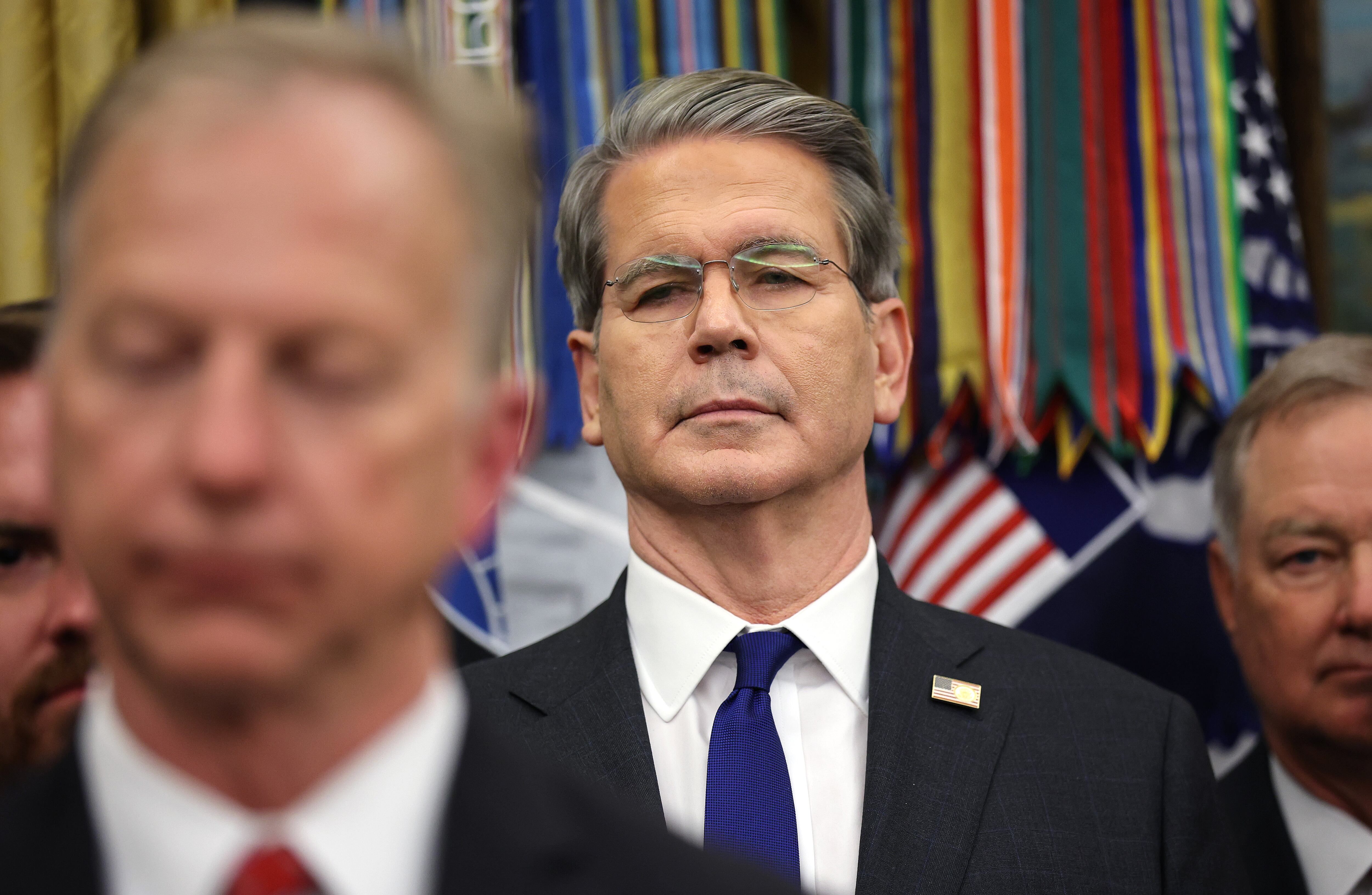
When Treasury Secretary Scott Bessent (above) and Fed chair Jay Powell jointly summon America’s top bankers to a meeting in Washington, you know it’s big. This time, it was over the specter of a new AI model created by Anthropic, called Mythos. If that sounds like a black-masked, sword-wielding supervillain, then it has a great name, because that’s what it sorta is.
Before its public release, Mythos was let loose on the software running some of the biggest U.S. banks and it found flaws, faults and backdoors that had sat undiscovered, and uncorrected, for decades.
Details of the closed meeting last week are scarce, but President Trump’s chief economic adviser, Kevin Hassett, told Fox News the Administration is “taking every step we can to make sure that everybody is safe from these potential risks, including Anthropic agreeing to hold back the public release of the model until our officials have figured everything out. There’s definitely a sense of urgency.”
Anthropic is milking the supervillain for all its worth. It changed the model’s name from its original Capybara, an oversized, lovably cute South American hamster, and said it won’t release Mythos until a group of about 40 tech firms, including Apple, Amazon and Microsoft, get to use the model to scout for potential security breaches, and “give good actors a headstart.” It’s calling the group “Glasswing,” and offering $100 million in Claude usage credits to the project. But how serious a problem is it? Big Business This Week columnist Peter Green spoke with some cybersecurity experts to learn more.
“AI is becoming a very credible opportunity/threat to the financial system,” said Jim Taylor, president and chief product and strategy officer at RSA Security, a respected internet security firm. AI is “industrializing” the speed and frequency of fraudulent transactions, way faster than banks and businesses can keep up.
A recent survey by tech consulting firm SAS found that 47% of banks are caught in what the firm calls a “trust dilemma,” either deploying AI they haven’t fully validated or holding back AI they’ve validated and trust. More than the technology itself, the lack of people and procedures to manage the overnight growth of AI is what many regulators increasingly view as a systemic risk, the preparedness gap the Treasury and Fed are concerned about.
The other big problem, said Taylor ,is the way AI is getting incorporated into the global financial system. “It’s automation, it’s cheap, it’s better, it’s easier and more effective than a human. But if you start to rely on those AI models, the models themselves become a risk: what if those models are manipulated or they’re simply wrong?”
The big question, and what was probably behind the Washington convocation, said Taylor, was concern about how much knowledge banks have to understand and limit the risks of the AI they are incorporating at record speed.
“The Mythos announcement, there's a fair amount of hype around it,” said Jeff Williams, chief information security officer for Sigma 360, which provides compliance software to large financial institutions. Other AI models, some far simpler and less expensive to run than Mythos, have already found and exploited major security flaws, he said, putting hacking tools within reach of almost anyone with ill intent.
“That means that the barrier to an attack is suddenly lower,” Williams said. “How much lower is open for debate,” but he noted, “the fundamentals of security haven't changed.”
That’s where security experts agree: credentials, identification and privilege go by many names, but the key to IT security is to ensure that only authorized users are entering your system. AI makes that a lot harder. It can gather hundreds of data points from confirmed users, everything from their syntax to their location or even their typing patterns, and fake their way into the system, erasing databases or diverting funds into fake bank accounts with fake invoices.
“We need to operate from a principle of least privilege,” said Williams. “We need to control our systems in a meaningful way so that they're only doing the things that they're supposed to do, that we can see that they're doing them correctly.”
The lesson for defenders is that if attackers can move that fast, defenders have to move even faster, and that’s a problem for many large corporations, added Walker. “Legacy compliance tools and security tools aren't very well positioned for this increased pace. It takes a move to continuous compliance operations that leverage AI. That gap is not just technology, but also the people and process behind it, have you built a cadence that will allow rapid response to emerging threats.”
That capacity will take time to build, training people in new work methods, and creating roadmaps to speed the defense against AI-run hacking.
One interim solution, that may prove most durable, is to wall off key data on a server that is only reachable via what’s called an “air gap,” physically disconnecting from the internet, and using non-digital means to keep the data isolated.
“AI can’t circumvent physics,” said Tony Hasek, CEO of Goldilock Secure, a new NATO-standard air gap database protection device used by some U.K. utilities. “The databases are physically disconnected,” explained Hasek. “Since the AI can only operate with Internet Protocol, if access to the databases is triggered by methods that don’t use the internet, there’s no way for the AI to break in.”
The weakest point in the armor around the financial system and its data are humans, says Shai Gabay, founder of Trustmi, a New York-based cybersecurity firm focused on countering AI identity fraud. AI gets better by the day at social engineering, detecting and duplicating the bits and pieces that make up a person’s online identity. “Attackers understand how companies actually operate, and they’re using that to slip through gaps that tools were never designed to catch,” Gabay said. “The one thing that you cannot fix, it’s not software vulnerabilities, it's the human beings, and that's why social engineering is very effective because it's targeting the human being behind the computer.”
The problems need to be solved soon, to prevent the erosion of public trust in the banking system. “AI failures can undermine trust far faster than traditional risks, because flawed models, biased decision logic and ungoverned automation don’t remain isolated. By their very nature, these failures can cascade across customers, counterparties and markets in real time,” said Stuart Bradley, senior vice president for fraud and security intelligence practices at SAS, the data security consulting firm. “The potential for a sudden loss of confidence cannot be understated in today’s digital‑first financial system, where bad news spreads like wildfire and customers can move their money in an instant.”
That, says Goldilock’s Hasek, means globally regulators and financial institutions will need to work together to keep an eye on how AI is used.
“Everybody has to be willing to regulate it, because if one venue doesn’t regulate it,” he said, “we may be in deep trouble.”
—Peter S. Green
Big Businesses mentioned this week:
$DIS ( ▲ 0.38% ) $AMZN ( ▼ 1.74% ) $GOOG ( ▼ 1.68% ) $FLYYQ ( ▲ 33.33% ) $TSLA ( ▼ 2.15% ) $BIRD ( ▼ 6.55% ) $SNAP ( ▼ 6.01% ) $PTON ( ▼ 3.07% )
This week, big business!
War story
It’s open, it’s not open. Whatever is happening with the blockade of the Strait of Hormuz, one thing is for sure: Oil, fertilizer and chemicals are not getting to market, and the price of these basic building blocks of the global economy is hurting everyone (except maybe the arbitrageurs). Up next: Farmers. Across the globe, fertilizer shortages and resultant price hikes are upsetting the delicate calculus farmers use to decide what crops to plant. A survey this week showed 78% of farmers in the U.S. South can’t afford all the fertilizer they need. So many are dropping corn and switching to less fertilizer and energy intensive crops, like soy beans. As one farmer told CNBC: “We are paying input prices of 2026, but getting crop prices of the ’70s and ’80s.” Except for tomatoes: Fresh tomato prices jumped 15% last month to an eight-year high, mostly due to tariffs on Mexican tomatoes and higher energy costs. Time to plant a Victory Garden?
Global growth drop? With oil prices bouncing around $95 a barrel for global benchmark Brent Crude, up nearly 50% since before the war began on Feb. 28, it’s unlikely that prices will fall much lower anytime soon. And that’s bad news for the global economy, says the International Monetary Fund., which expects global growth to drop to 3.1% this year from a previous forecast of 3.4%. If the war drags on, global growth could drop to 2% and send inflation up to 6%. It predicts U.S. growth will drop to 2.1% from January’s forecast of 2.4% this year. The U.S. Bureau of Labor Statistics said March inflation hit a 3.3% annual rate, up from 2.4% in February, before the war started, with the national average for a gallon of gas hitting $4.11 this week.
(Google)
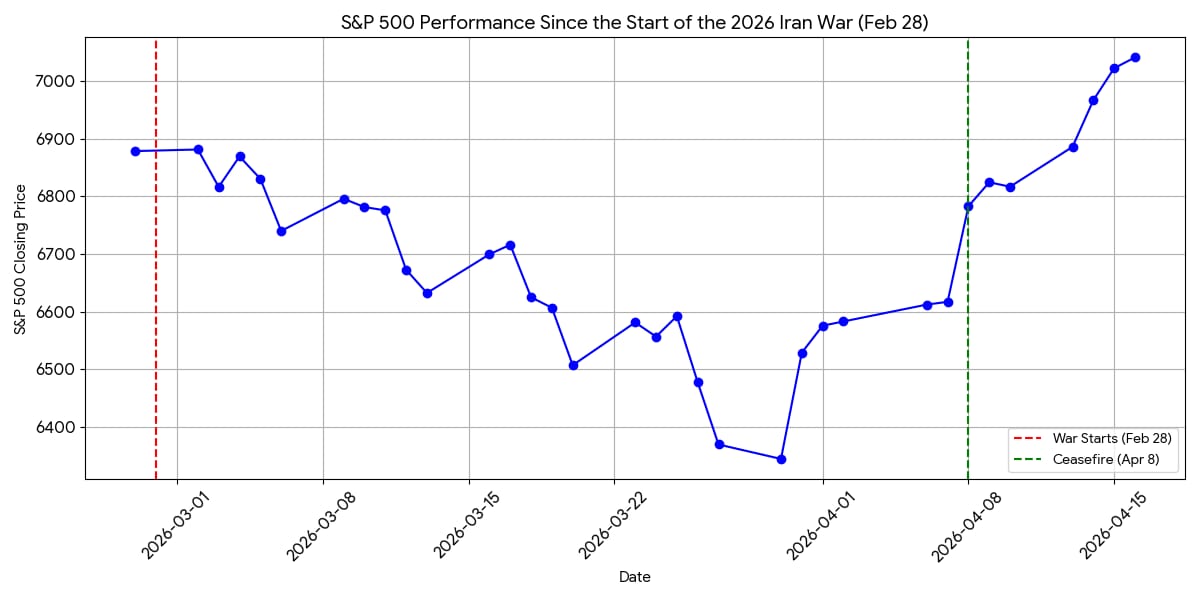
Markets Drinking Kool-Aid? None of this has hurt the stock market, which just keeps climbing. On Wednesday, the S&P broke 7,000, setting a new record, even as the U.S. Navy began stopping some ships from transiting the strait,and Iranian forces keep hundreds of tankers bottled up in the Persian Gulf, unless they pay a dollar-a-barrel toll. It’s hard to know what’s keeping the market booming, but there are some indicators: corporate profits are still going strong, and whatever happens in Iran, investors are clearly counting on TACO - believing that with mid-term elections coming and his favorability rating in the basement (56% of American disapprove of the job he’s doing), Trump won’t risk more war. But maybe it’s the employment numbers that are helping out. JPMorgan Chase CEO Jamie Dimon said Tuesday, “The most important thing is jobs, and there are plenty of jobs.” But former Fed and Bank of America economist Ethan Harris says markets aren’t pricing in the real risk that high oil prices are here to stay, noting that countries that are shut off from Gulf oil and gas will soon be buying from the U.S., pushing domestic oil prices closer to world levels, meaning we are closer to a recession than it may appear. “I’m not drinking the Kool-Aid,” he wrote in a blog post this week.
ADVERTISEMENT
The 10 Best Cheap Stocks to Buy Now

The market is expensive… historically expensive.
Most of the biggest stocks are already fully priced. Capital has crowded into the same mega-cap names — making true value harder and harder to find.
By early 2026, institutional money had stayed concentrated. Smaller companies had been overlooked. And beaten-down names had been left behind.
But here's the real question…
When the broader market is this expensive — which stocks are still cheap enough to offer real upside?
Our new report reveals 10 undervalued stocks trading under $10 per share — from companies too small for institutional money managers to touch… to out-of-favor names already working their way back.
If you're looking for real value in an overpriced market, start here.
END OF ADVERTISEMENT
The usual suspects
Evictions at the House of Mouse: New Disney $DIS ( ▲ 0.38% ) CEO Josh D’Amaro says he’s laying off 1,000 more Disney mice as he consolidates the company’s multiple marketing arms in a single division. That comes after former CEO Bob Iger sacked about 7,000 Disney employees since he came back to the company in 2022 and began a major realignment of the business. Disney had about 230,000 employees at the end of last year, so the cuts may appear small, but the company is struggling to cope with shrinking revenue in TV (streaming is not making up for the fall-off in TV viewers) and with competition from Amazon $AMZN ( ▼ 1.74% ) and Alphabet-owned $GOOG ( ▼ 1.68% ) YouTube. Shares in Disney are up 12% since a March 27 low, when investors appeared to buy the dip after Barclays upgraded the stock, amid hopes for a new "Frozen” attraction at Disney theme parks.
Dead Spirit? That’s all she wrote, folks. Spirit Airlines $FLYYQ ( ▲ 33.33% ) could be liquidated as early as this week, according to CNBC, citing people familiar with the situation. Despite givebacks by union pilots and flight crews, rising fuel prices, shrinking margins on barebones economy seats and a foiled merger with Jet Blue left Spirit nothing to hang on wth. Spirit had forecast a $252 million profit last year, but by August said it had lost nearly $257 million in less than four months, after exiting Chapter 11 bankruptcy in March. It filed for Chapter 11 bankruptcy protection again less than a month later. “We don’t comment on market rumors and speculation,” Spirit said in a statement.
Jeff and Elon’s Big Satellite Battle: It seems like Jeff Bezos is having a case of satellite envy. With Starlink chief Elon Musk having launched more than 1,100 satellites for his Starlink network, Bezos’ is scrambling to get Amazon’s own satellite comms system in orbit while he can still compete. With only 27 sats in place so far (admittedly, they are a lot bigger than Starlink ones) Bezos’ has been looking for quick fixes, and he’s found one with Globalstar, which has 24 satellites. Amazon will pay $10.8 billion for the new space toys.
Place your bets. Kalshi and Polymarket, both of whom have hired Donald Trump, Jr. as an advisor, are facing off against Congress as legislators agitate to more closely regulate the online prediction businesses. By structuring their deals as contracts, rather than as bets, the two companies say they’re governed by the Commodity Futures Trading Commission, which also governs futures contracts (or bets) on real deliverables like pork bellies and gasoline. Instead of betting on a sports game, for example, you invest in the outcome. Senators don’t like the prediction markets betting on wars, and casinos and licensed sports books say the companies are eating into their businesses. The two firms are beefing up their lobbying, having spent a collective $1 million in Washington last year.
If you can’t trust the NFL… Football may be one of the most competitive games on the planet, but the Justice Dept. says it’s investigating anti-competitive practices by the NFL. The topic is broadcasting games, and the DoJ says it’s got questions about “affordability for consumers and creating an even playing field for providers,” according to an unidentified DJ official speaking to CNBC. The league said 87% of its games can be seen for free on local broadcast TV channels. Meanwhile, a poll by Sacred Heart University shows Americans don’t have much trust in the NFL, with only 31.7% calling it the league they trust most not to let betting influence games.
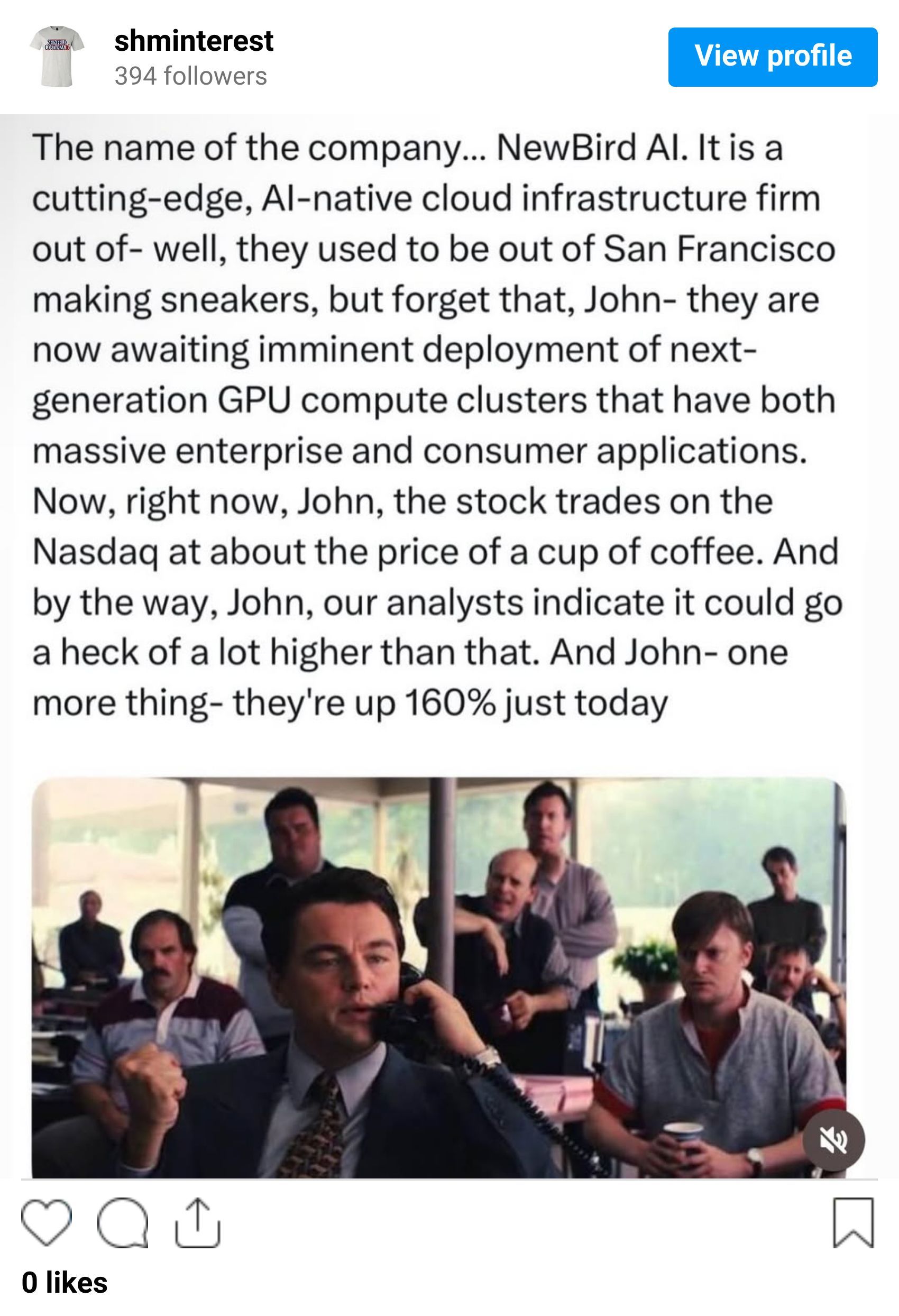
You know it’s a bubble when… What do you do when you’ve run your $4 billion footwear firm into the ground? Pivot to AI. That’s what failed shoemaker Allbirds $BIRD ( ▼ 6.55% ) , a one-time Silicon Valley sartorial standard, just did. Two weeks ago, Allbirds sold its IP and remaining assets for $39 million. After kicking off its kicks, Allbirds’ share price jumped from $3 to $17 this week, on word it’s entering the AI compute business, leasing GPUs, hardware and access to smaller companies. It’s rebranding itself as “NewBird AI.”
Is Detroit back - With drones? Facing a long-neglected drone gap with adversaries like Iran, Russia and China, the Pentagon is starting to wise up, and has approached U.S. automakers about becoming armsmakers. Already, drone startups are relocating to Detroit, with its cheap office space, reusable factory buildings, and cheap housing. They are also finding car parts suppliers with spare manufacturing capacity, and machinery that can easily be reconfigured to mass produce drone parts. The idea is not new. During World War Two, GM $GM ( ▼ 1.13% ) became the world’s largest arms maker, churning out more than 6,000 Cadillac-made tanks, and 13,000 Navy airplanes.
Oh, Snap! Blame AI for this one: Snapchat parent Snap $SNAP ( ▼ 6.01% ) , says it’s laying off 1,000 people, or 16% of its global workforce because of AI-generated efficiencies. Shares were up nearly 8% by day’s end Wednesday, but Snap’s lost more than 90% of its market cap in the past five years. AI agents are already generating over 65% of Snapchat’s new code and responding to over 1 million queries per month. Snapchat is also getting squeezed by deeper-pocketed social media rivals. Facebook, Instagram, YouTube, and TikTok capture over 90% of social media ad spending, according to data firm Omdia.
The short stack
Peddling a new Peloton: New CEO Peter Stern is planning to expand Peloton $PTON ( ▼ 3.07% ) from the ridiculed exerbike of choice to a full fitness brand with exercise equipment for gyms and AI-curated exercise routines. Stern says most of the Peloton users who bought bikes during the pandemic are still using them. Still, shares are down 96% since their pandemic-era high.
The annoyance economy: All that time you spend on hold talking to helpline bots, trying to fill out an insurance claim form, make a doctor’s appointment or place an online order? Well, a new study by policy wonk Chad Maisel and Stanford econ prof Neale Mahoney has put a number on what they call the waste of the “Annoyance Economy.” It’s $165 billion a year! Their solution: better regulation that restricts monopolies and re-awakens competition and consumer protection. Good luck with that.
Trumplandia
The Apprentice, Fed Chair edition. The clock is ticking on Fed chair Jerome Powell’s tenure, but the GOP-controlled Senate seems uninterested in resolving the question of who’s going to replace Powell when his term expires on May 15. President Trump’s nominee, the Kevin named Warsh, the gazillionaire son-in-law of Trump buddy and cosmetics heir Ronald Lauder, is stuck in committee, as Banking Committee member North Carolina Republican Thom Tillis says he won’t approve any nominee until the Trump Administration ends its investigation of Powell for the over-budget and over-schedule renovation of the Fed’s D.C. headquarters. Earlier this week, Justice Dept. investigators made an unannounced visit to the construction site, and now even Senate Majority Leader John Thune says it's time for Trump to drop the probe, widely seen as an effort to intimidate Powell. Trump wants to install Warsh, who says there’s room to lower interest rates, a Trump priority. But Warsh may face further hurdles over his $130-million-plus personal fortune, which he’d have to divest or put in a blind trust. Senators from both sides say they’ll grill him on how he’d secure the Fed’s congressionally mandated independence in the face of Trump’s rate rage. Meanwhile, Trump said he’d fire Powell if the chair stayed on beyond May 15. Law and custom say the Chair goes only once his successor is appointed, so expect quite a showdown as the Senate gets back in session.
Oil Insiders? Remember those curious oil futures and S&P trades last month just minutes before President Trump announced a ceasefire with Iran that sent the markets reeling? Well, the Commodities Futures Trading Commission says it's looking at trading platforms run by CME Group and Intercontinental Exchange, asking them to turn over records. Regulators want Tag 50 identifiers on a number of trades. Now called operator IDs, they show which individual or account made a trade on a futures exchange. CME shot back, saying it works with the CFTC, but said any review should include those prediction markets, Kalshi and Polymarket.
You’re clearly into smart people talking about even smarter things. Lucky for you, that's literally our whole deal at Cheddar. We interview the brightest minds in business, finance, and tech. If you'd like more in-depth analysis from interesting people, lcheck out our where to watch page and turn us on 24/7! Your wallet will thank you and so, more importantly, will your mind. But also your wallet. Remember that.
Peter S. Green is a veteran reporter and editor who has spent more than two decades covering business and finance from Eastern Europe to New York City, and has worked for Bloomberg News, The New York Post, The New York Times and The Messenger. He lives in New York City and is always looking for the next big story. Email him here.