- Big Business This Week
- Posts
- Will new pressure on Fed chair Jay Powell backfire on the U.S. economy?
Will new pressure on Fed chair Jay Powell backfire on the U.S. economy?
Plus: Paramount won't take no for an answer as it sues Warner Bros. in a hostile takeover attempt

Cheddar's Big Business This Week
January 15, 2026

The image was stark. Fed chair Jerome Powell stood in front of the American flag staring straight at the camera. Just two days earlier, President Trump’s Justice Department threatened criminal charges against Powell over a $3 billion renovation of two century-old Fed buildings in Washington. The move came after months of pressure on Powell from Trump, who says Powell is moving far too slowly to lower rates, and has publicly threatened to remove Powell, belittled him, and called him “too-Late” Powell.
“This is about whether the Fed will be able to continue to set interest rates based on evidence and economic conditions — or whether instead monetary policy will be directed by political pressure or intimidation,” Powell said.
The last 12 months have seen an extraordinary change in the way the U.S. economy works. From pressuring the Fed to lower rates to telling investment firms they can’t buy single-family homes, imposing and lifting sector-specific tariffs, or deciding who can sell chips to China, the Trump Administration has taken a heavy hand in the economy.
By some measures, analysts say, that hasn’t been working out very well.
“When a government intervenes in the economy to try to set the ‘appropriate’ price for something, you end up with shortages, which only drives up prices,” said Chris Hodge, chief economist at Natixis Corporate & Investment Banking, and a former Fed and Treasury official. “You remove the economic incentive for private sector actors to set whatever the appropriate prices are.”
Often, in fact, the effect tends to be the opposite of what was intended. “The pressure being applied to the [Fed] and to Powell specifically, is going to be counterproductive,” said Hodge. “Bond yields and mortgage rates are a function of inflation expectations, and growth staying steady, but growth is not going to stay steady if the government continuously puts its thumb on the scale in the private sector economy, and inflation expectations are not going to be well anchored around 2%, the Fed’s target number.”
Luigi Zingales, a professor of finance at the University of Chicago's Booth School of Business, doesn't mince words.
“This is a power grab move to scare everybody,” Zingales said of Trump’s investigation of Powell on his podcast Capitalisn’t. “He's doing that to prove that he has absolute power. You can be attacked, criminally attacked, criminally indicted for resisting Trump.”
The problem, noted Zingali, is that attacking Powell ultimately makes it harder for the Fed to lower interest rates. “By using the sledgehammer, [Trump] all but ensures that the next Federal Reserve meeting will not cut interest rates.”
And why hasn’t the market reacted violently to the assault on the Fed? That may be, said Zinglaes, because the U.S. dollar has a virtual monopoly when it comes to being a monetary safe haven. “You have no alternative,” said Zingales. “The U.S. dollar is the international medium of exchange and it is very difficult for anybody to go anywhere else. And at the end of the day, if you want to save assets, you're going to invest in U.S. Treasuries. What is the alternative?”
That doesn’t mean the White House should stay out of the economy altogether, says Michael Ashley Schulman, chief investment officer for Running Point Capital Advisors, a multifamily office.
“The real question is whether it’s helping the game stay fair,” Schulman says. “Investors can live with rules, taxes, and even occasional clumsy refereeing, but struggle to price a world where property rights feel negotiable, contracts feel political, and capitalism starts to look like a subscription service that can be cancelled when it becomes inconvenient. When the White House leans on the Fed, markets charge an uncertainty premium through higher long-term Treasury rates, shakier expectations, and more apprehensive risk appetite.”
—Peter S. Green
Big Businesses mentioned this week:
$PSKY ( ▲ 2.9% ) $WBD ( ▲ 0.03% ) $JPM ( ▼ 0.02% ) $AAPL ( ▲ 0.5% ) $GS ( ▼ 1.63% ) $MPC ( ▼ 2.41% ) $VLO ( ▼ 3.91% ) $PBF ( ▼ 3.77% ) $GOOG ( ▼ 2.35% ) $NVDA ( ▼ 4.23% ) $MSFT ( ▼ 1.7% ) $BP ( ▲ 0.24% ) $WMT ( ▲ 2.25% )
This week, big business!
The usual suspects
Loony Tunes: David Ellison and dad Larry, the Oracle $ORCL ( ▼ 3.46% ) founder and gazillionaire, just won't give up in their pursuit of Hollywood studio and media giant Warner Bros. Discovery $WBD ( ▲ 0.03% ) . After the Ellsion’s Paramount Skydance $PSKY ( ▲ 2.9% ) sued the Warner Bros. board this week to get more information about why WBD chief David Zaslav and his board have rejected their offer for the studio and all its assets, rival bidder Netflix $NFLX ( ▲ 3.32% ) appears ready to up its offer to an all-cash deal. Netflix’s current cash and stock deal is valued at about $27.75 per WBD share, but that’s after WBD completes a planned spinoff of its cable and broadcast properties. Paramount is offering $30 a share for everything, but that’s at the core of the problem because Paramount, with a $13 billion market cap, is a far weaker financial prospect than Netflix, with a market cap of about $405 billion. The Ellisons are counting on a pile of debt, as well as cash from Middle Eastern investment groups, to close the deal. WBD’s board has said the risk of that deal falling through is high. An all-cash offer from Netflix could also shorten the timeline, with a shareholder vote on the sale coming as soon as next month.
Saks declares bankrupcy: America’s department stores have long been an endangered species, but it’s taken a while for the pre-eminent U.S. luxury retailer to catch on. This week, Saks Global, the parent company of the iconic Saks Fifth Avenue and ultra-luxe retailers Neiman Marcus and Bergdorf Goodman, filed for bankruptcy protection. The proximate cause was a stack of debt from the 2024 $2.7 billion acquisition of Neiman Marcus and Bergdorf (financed with $2 billion in debt) and the ire of creditors after Saks missed a $100 million payment in December. The real reason is arguably the inability of large retailers to adapt to changing trends. More Americans buy clothes online, and mega-luxe brands from Louis Vuitton to Fendi have their own retail outlets now. The bankruptcy plan is meant to keep the business running, and Saks says it will close some of its 33 Saks stores, 36 Neiman Marcus stores, and 70 Saks Off Fifth discount outlets. But there’s been some further talk in New York about the valuable Fifth Avenue flagship across from Rockefeller Center: creating a slimmed-down department store on the lowest floors, and converting the rest to a luxury hotel.
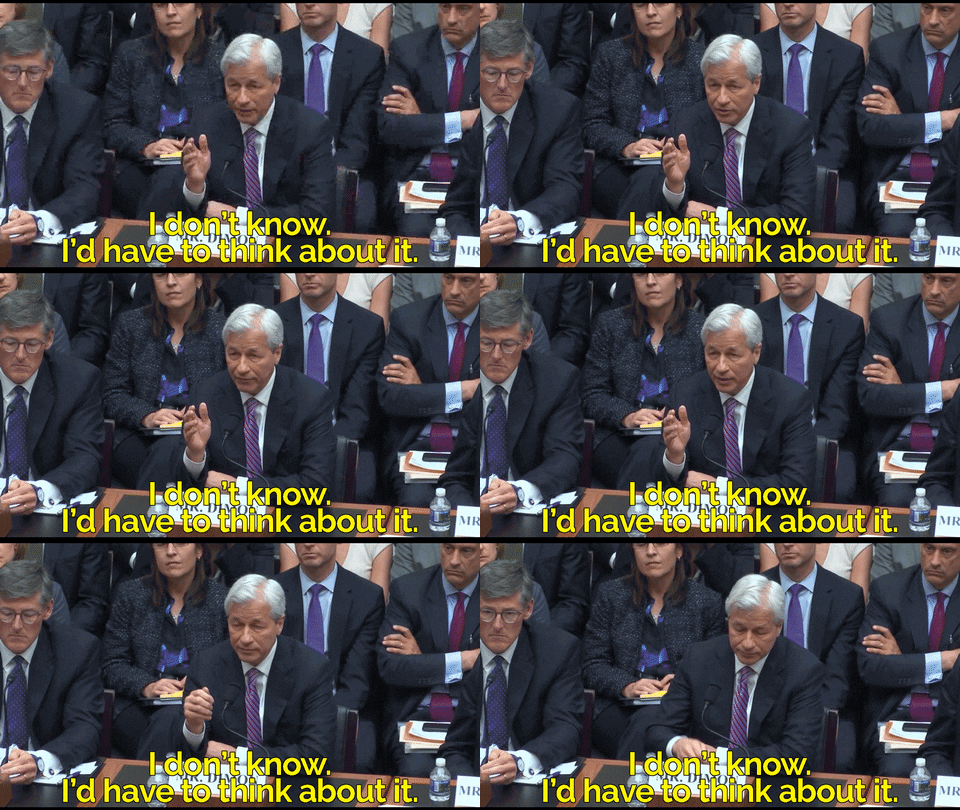
JPMorgan Chase CEO Jamie Dimon
Dimon in the rough: Fresh off his reported $770 million in compensation last year, JPMorgan Chase $JPM ( ▼ 0.02% ) CEO Jamie Dimon said the largest U.S.bank saw profit fall 7% in the fourth quarter, as investment banking fees dropped on a slowdown in IPOs, and the company took a $2.2 billion charge for potential loan losses on the Apple $AAPL ( ▲ 0.5% ) credit card business it will take over from Goldman Sachs $GS ( ▼ 1.63% ) . Speaking of which, JPM’s 2025 profits hit $57 billion, not quite 2024’s $58.5 billion, the largest profit ever recorded by a U.S. bank.
Drill, baby, drill: That’s BP’s $BP ( ▲ 0.24% ) new motto, after the UK-based energy giant said it’s taking a charge of up to $5 billion as it walks away from renewables and low-carbon energy like natural gas to go back to drilling for oil. BP’s shares are still down about 12$ from a 2023 peak, but up 6.5% in the past week.
Droning on: Look, up in the sky; It’s a bird, it’s a drone, it’s a Walmart $WMT ( ▲ 2.25% ) delivery! Walmart and Alphabet’s Wing drone company say they’re expanding service to 270 Walmarts by the end of next year. Walmart's Wing service now just serves the Dallas area. Fueling the expansion has been a successful push by drone lobbyists to allow commercial drones to fly out of sight of their operators. That’s a help for drones that monitor powerlines in the wilderness and offshore drilling platforms, but municipal authorities are concerned about packages dropping out of the sky and drones smacking into trees or each other or civilians. We’ll let you know if and when that happens.
The alphabet now knows its 1,2,3’s—and 4’s. The Google $GOOG ( ▼ 2.35% ) parent became the fourth company in history to hit a $4 trillion market cap, sitting right below Nvidia $NVDA ( ▼ 4.23% ) ’s $4.56 trillion. Both Apple $AAPL ( ▲ 0.5% ) and Microsoft $MSFT ( ▼ 1.7% ) crossed the $4 trillion threshold last year, but have since slipped. Alphabet got a bump this week when Apple announced it was dumping its own AI effort and would be loading Alphabet's Gemini in its products.
ADVERTISEMENT
END OF ADVERTISEMENT
The short stack
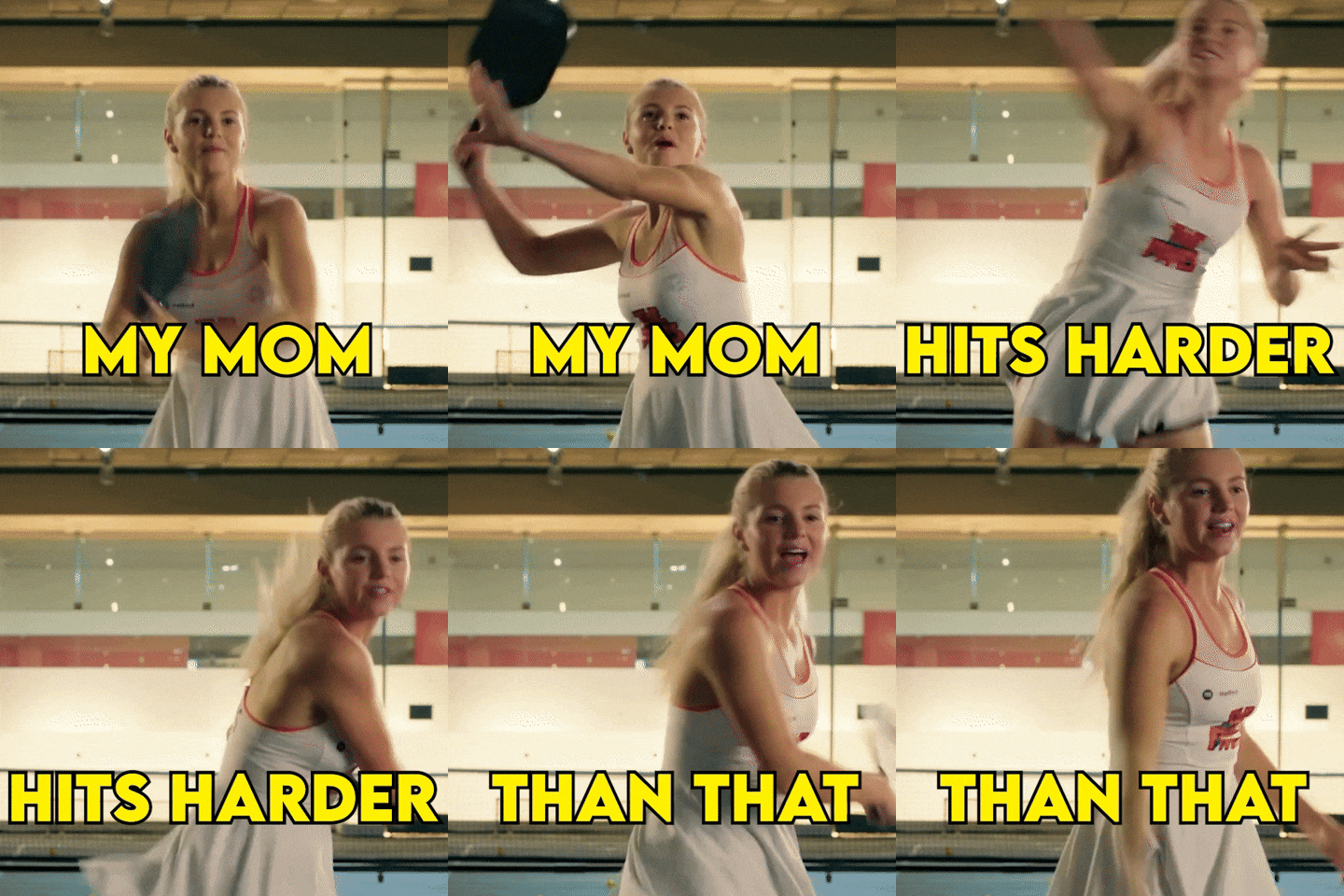
Nike’s first pickleball sponsoree: Anna Leigh Waters
Pickleball: Who said pickleball is just an irritating pastime for aging millennials? Not Nike $NKE ( ▲ 2.08% ) . The iconic sneaker brand has just signed its first pickleball sponsorship deal with 18-year old U.S. pickleball pro (yes, there is such a thing) Anna Leigh Waters, who will become the brand’s first global pickleball ambassador. Pickleball has become big business: the United Pickleball Association is offering $31 million in tournament prize money for pickleball pros this year. No word on how big Waters' contract is, but it's probably not quite up there with Michael Jordan’s, or the $1 billion-plus that LeBron James has secured.
Financial Follies: About that credit card crackdown. Jumping on the affordability bandwagon, President Trump said he wants credit card issuers to cap interest rates at 10 percent. Trump offered no clues about how he’d enforce the idea, a promise he campaigned on in 2024, but he’s already killed a Biden-era rule that capped credit card late fees at $8. Banks say that the ability to charge life-crushing interest rates (as high as 36% for some people with poor credit scores, and averaging about 19-24%) lets people with lower incomes get credit cards. “If you bring the caps down, you're going to get restricted credit, meaning fewer people will get credit cards, and the balance available to them on those credit cards will also be restricted,” said Bank of America $BAC ( ▲ 0.53% ) CEO Brian Moynihan, who earned $35 million in 2024. Then again, at 36% interest, maybe life without a credit card is better.
Oil Outlook: A handful of Gulf Coast refineries outfitted more than two decades ago to handle the heavy, sulfurous muck that’s pumped out of Venezuela could be back in the black. Back in 2018, the U.S. imported 500,000 barrels of Venezuelan crude a day, but late last year that number had dropped to about 125,000. If Venezuelan oil gets to the U.S., and there’s been no confirmation of any agreement, that would be a big boost for refinery owners, whose shares have jumped since Jan. 3, when U.S. commandos captured President Nicolas Maduro. They include Marathon Petroleum $MPC ( ▼ 2.41% ) (up 10%), Valero Energy $VLO ( ▼ 3.91% ) (up13%), and PBF $PBF ( ▼ 3.77% ) (up 15%).
Trumplandia
Inflation: What goes up just won't come down. This week’s inflation figures from the decimated Bureau of Labor Statistics showed there’s been little progress in trimming inflation, with core CPI stuck at 2.6%, about where it started the year. The problem is that hourly wages just aren't keeping pace, rising only around 1%. And that’s where the real affordability issue lies, says Douglas Holtz-Eakin, former director of the Congressional Budget Office. The solution, he says: “The administration should focus on getting the labor market back to life. Of course, the decline started with the announcement of the tariffs in April. The obvious solution is a U-turn on tariffs, which is not going to happen. But the administration needs to develop an alternative, and quickly.”
China Trade surplus: So how did those tariffs work out for China? Very well, thank you. Despite a 20% drop in the value of exports to the U.S., China reported a global trade surplus of $1.19 trillion last year, up 20% from 2024. That was buoyed by export growth to Southeast Asia (up 13.4%, the EU (+8.4%) and Africa (+25.8%). Semiconductors (+26.8%), ships (+26.7%), and autos (+21.4%), were the top growth categories, the kind of products the U.S. used to export. Next week, China is expected to announce GDP growth of 5% for 2025, analysts from ING Bank wrote this week. The key question is how long China can keep up that growth. It’s facing trouble on two fronts: Rising protectionism abroad — Mexico has already ramped up tariffs and the EU is threatening to do the same, and while a weak currency keeps Chinese goods cheap abroad, it's raising costs for consumers at home, stalling domestic demand..
Let’s make a deal! Chicago-based biopharma giant AbbVie, the company formerly known as Abbott, says it’s cut a deal with the Trump Administration to avoid tariffs on imported drugs in exchange for promising to invest $100 billion in the U.S. over the next 10 years, and selling some of its meds direct to patients through the government’s new pharma portal, called TrumpRx. Last April, AbbeVie pledged to invest $10 billion by 2035. It’s not clear if that investment is rolled into the new pledge. AbbeVie has about 6,000 employees across 11 plants in the U.S.
Elon’s World
Grok’s XXX Trouble: Grok’s got an image problem: Its xAI-powered image-generating features have been enabling users to create millions of explicit, deep-fake nude photos of ordinary people, mainly women and children, performing sex acts without their consent. California’s Attorney General Rob Bonta said the images are being used to harass women and children across the web. In a statement on Wednesday, Bonta said he’s launched a criminal investigation. “xAI developed Grok’s image generation models to include what the company calls a ‘spicy mode,’ which generates explicit content,” Bonta said. “The company has used this mode as a marketing point.” Bonta’s probe comes days after India, Malaysia, Indonesia, Ireland, the U.K., France, and Australia, as well as the European Commission, launched their own investigations. Malaysia and Indonesia have already moved to suspend Grok. “It’s disgusting,” U.K. Prime Minister Keir Starmer said. Musk said Wednesday he was “not aware of any naked underage images generated by Grok,” and blamed “user requests.” U.K. media later reported that X has agreed to eventually block users from creating deep fake nudes and bathing suit pics, if Parliament passes a law banning the posts.
Want more Cheddar?
You’re clearly into smart people talking about even smarter things. Lucky for you, that's literally our whole deal at Cheddar. We interview the brightest minds in business, finance, and tech. If you'd like more in-depth analysis from interesting people, lcheck out our where to watch page and turn us on 24/7! Your wallet will thank you and so, more importantly, will your mind. But also your wallet. Remember that.
Peter S. Green is a veteran reporter and editor who has spent more than two decades covering business and finance from Eastern Europe to New York City, and has worked for Bloomberg News, The New York Post, The New York Times and The Messenger. He lives in New York City and is always looking for the next big story. Email him here.